I was very impressed by Steve Wendt’s scooter tow clinic. Towing with the scooter seemed easy, safe and fun. Towing has been done in various forms since the very early days of the sport. So what’s different about scooter towing?
(Also see: WW Scooter Towing Resources Page)
Overview
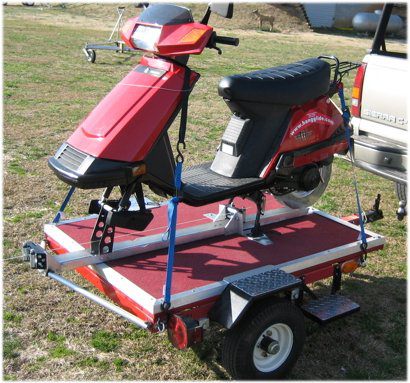
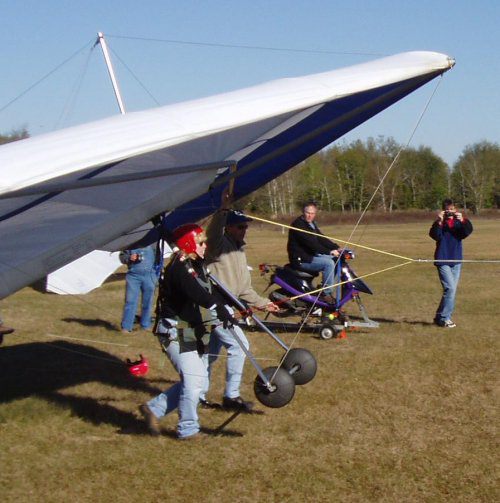
A 50cc, 4.5 horsepower scooter is mounted to a trailer. A drum replaces the back wheel and is wound with several thousand feet of spectra line. Wheel chocks are placed in front of the trailer’s wheels. A return pulley is attached to a screw in the ground about 1000 feet upwind of the scooter. The tow line is taken buy an ATV to the pulley and then back to the glider beside the scooter. A traffic cone is placed on the ground along side the tow line 200 feet short of the return pulley as a target to land beside . A standard aerotow top release is mounted about 6 inches ahead of the control bar apex. A v-pull is attached to the top release with a weak link, through a loop in the the tow line, and then to the student’s harness via tow loops at the hips. A barrel release is used on the lower v-pull. A back strap is used to prevent the tow line from pulling the harness away from the student’s body. With the student standing next to the scooter operator / instructor, it is easy to give instruction in a conversational tone. In no wind the launch consists of two walking and several running steps to get flying. If the student makes a mistake you simply close the throttle and land them. The tow line stays attached to the student for early flights right through the landing, so they do not have to worry about releasing it. After about ten flights Steve switches them to a Falcon 2 and gradually pulls them higher. During this phase of training he teaches them how to release the tow line and do small turns. These tows go up to an altitude of about 75 feet.
Once they have mastered the release and small turns Steve switches to a 125cc scooter. With more power and a longer tow line he will pull them up as high as 700 feet. The release and bridle for this stage of towing is similar to a truck tow set up, with the tow bridle going through loops near the pilot’s hips and then up to the carabiner. There are two different length bridle lines attached to the tow line and then to a three string release, and a barrel release. The top line is released by the pilot at about 100 feet and now the line running under the base tube provides the tow force. In this stage of training the student will learn approach patterns and they will eventually be landing right back at the scooter for their next tow. Now they can get multiple tows with virtually no walking at all! He also demonstrated launches out of an aerotow cart with this scooter. Because one line is supposed to go below the base tube, I believe it would be extremely important to place a fabric cover between the front and back cross tubes of the dolly, otherwise it is just a matter of time before someone takes the cart for a flight on the tow line. This mistake has resulted in two fatalities that I know of, one in Argentina, and one in Arizona. Both of those flights were aerotow where the v-bridle should have bee above all tubes.
Low cost
Steve has done more than 16000 tows over the past eight years with two different scooters. He built each of them for under 2000 dollars. The only maintenance he does is to change the oil once a year, charge the car battery that starts the scooter once a month, and puts in gas. He’s using the old spectra line from his ATOL truck winch and has never needed to replace it. This makes his out of pocket cost for a tow less than 50 CENTS!
Low stress
This is probably the least stressful flying I have ever done. The 330 Condor flys very slowly, and you are gently pulled for hundreds of feet across level ground just five feet above it. Committing to running head long down a hill is not required.
Low operator skill required
Unlike more powerful tow systems, the small scooter does not require a highly skilled operator. I was surprised at how easy it was to pull Steve on my very first try. It was very simple to control his height and to set him down right next to the target cone. Steve actually lets his students operate the scooter to pull him on his demonstration flights.
Any open field becomes a training hill
Open fields are easy to come by, good training hills are not. Just think about how often a student goes for a lesson only to find that the wind direction is wrong. With the scooter, when the wind changes direction, the tow direction can be changed in 5 minutes by simply relocating the return pulley. I believe there would be more quality instruction going on if it was possible for the instructors to make a decent living. This method is the best I’ve seen for giving the instructor a tool to allow him to get results, and make a living teaching hang gliding or paragliding.
Low fatigue
Steve drives a four wheeler out to pull the tow line back for the next flight while the student just rolls the glider back on the wheels. Steve uses the time driving next to the student to critique their flight. Because there is no hill to climb, the student can get many more flights in a day before becoming tired.
Lots of takeoffs and landings
It’s easy to get ten or more flights per hour. This gives the students lots of practice in the two most import aspects of flight operations – launches and landings.
Replace other forms of towing?
Like other forms of winch towing you can’t necessarily tow the pilot to the lift like you can when areotowing. However, because it is so inexpensive to operate, and so easy to get multiple flights, you can get in a lot of flying (and launches and landings) in a very short time. The scooters are also very low noise compared to tow planes so there should not be problems with the neighbors.
Not foolproof
Steve describes all forms of towing as being like a loaded gun. He believes that even a small scooter, if misused, can be dangerous. If the scooter is used in conditions that are too strong, or if the pilot were allowed to over-fly the return pulley while attached to the tow line the results could be disastrous. As we’ve all learned the hard way over the years, when towing is involved there seems to be an almost infinite number of things that can go wrong if extreme care and judgment are not used. It does seem that the lighter the available tow force, the slower, and safer the tow will be. Steve is very conservative in his methods and stops towing the Condor as soon as the wind becomes more than a gentle breeze. In 16000 tows he has had two minor injuries, which probably is much lower than comparable training hill stats. Steve was a high school math teacher by profession. His enthusiasm for teaching is obvious, and he is really good at it. I’ve encouraged him to do a thorough write up on his methods so they can be used by other instructors. I believe that if we can make flying easier and less intimidating to learn, more profitable for the instructors, and more accessible to the public, we can help the sport to grow again.
Make more new pilots?
A number of major schools that teach both solo flight and tandem have told me that they get a much larger percentage of their students to sign up for a lesson package and become pilots if they learn to launch solo before going tandem. The major trend in hang gliding instruction in recent years has been to take a student up for a tandem as their first hang gliding experience. We have seen a decline in the number of people flying over this same period. Could it be that a tandem is a scary experience for most people, or that they get to say they have “flown a hang glider” and have therefore scratched the itch? Or perhaps the solo flying experience allows them to see that they can actually control the glider prior to going to altitude so the experience is less intimidating.
Big slow glider
Steve Pearson designed the 330 Condor for small training hill use, and did not intend it to be towed, or flown higher than a few feet off the ground, or flown in turns of more than a very gentle bank angle. The design goal for the Condor was to achieve a very slow ground speed in very light wind or even no wind at all. With a normal size glider, to achieve such slow ground speed would require a moderate wind, and moderate winds almost always involve gusts or turbulence, which complicate the training experience. The goal for the Condor was to allow flight at slow ground speeds in winds light enough to be reliably smooth. To achieve this design goal, Steve made the Condor very light and very large (53 pounds for a 39 foot span and 330 sq feet). With its very light structure it is only good for a little more than 3 Gs. Also, there are some stability and control characteristics in the Condor that are not a problem if the glider is used only within the stated limitations, but which would never have been tolerated in the design of a utility class glider. The Condor can become unstable at bank angles of more than 25 degrees, and can be unstable in pitch at even moderately higher speeds. We sell the Condor only to schools, for solo pilot training under direct instructor supervision, and we recommend that bank angles be limited to 15 degrees, that airspeed be limited to no more than 24 mph, and that altitude be restricted to no more than 20 feet above the ground (lower than that is better). We are very concerned that the Condor NOT be flown outside its placarded limitations. We don’t feel that towing, in the usual sense in which that term is understood, is in any way suitable on the Condor. We recognize that if special techniques are skillfully used, towing with a very light and controlled pull can be used to simulate the gentle pull of gravity on a shallow training slope. Having directly observed Steve Wendt’s techniques, I am comfortable with the way Steve is using the Condor in his scooter towing program – as I never saw anyone get more than seven feet off the ground and he tows it VERY GENTLY. It is extremely important, however, that anyone using the Condor in this manner be fully aware of all of the limitations of the glider, and consistently use techniques that properly take those limitations into account.
| Specification | Condor 330 | Condor 225 |
|---|---|---|
| Area (ft^2) | 330 | 225 |
| Span (ft) | 39 | 35.8 |
| Aspect Ratio | 4.6 | 5.7 |
| Glider Weight (lbs) | 53 | 48 |
| Hook-In Weight (lbs) | 100-265 | |
| USHPA Rating | 1 | |
| Vne (mph | 32 | |
| Va (mph) | 24 | |
| Vms (mph) | 13 | 15 |
| Vd (mph) | 32 | 43 |
| Length (in bag) (in) | 290 | 249 |
| Short Pack (in) | 170 | 180 |
To Davis Straub (OZ Report): Thank you for your efforts to convince the USHPA to sponsor the sessions! Thanks also to the USHPA for doing so, to Quest for hosting the clinics, and especially to Steve Wendt of Blue Sky for so unselfishly sharing his scooter tow method.
Matt Taber writes
I was real impressed with Steve Wendt and scooter towing. I believe that it will offer an excellent inexpensive quality training solution to anyone that has a desire to teach.I was left reeling with the many ways to use the scooter winch at Lookout Mountain Flight Park.Besides being an all around excellent training tool I see it also as an excellent tool to use to promote hang gliding with — going to schools like UGA, UTC, Emory and Vanderbilt to demonstrate and possibly offer a intro class right at the campus. This would also be effective at military bases.The beauty in the machine is in it’s simplicity, portability, reliability (Steve claims over 15,000 trouble free tows on the same machine/rope) and versatility. With the same machine you can offer a very easy series of first flights or 200 or more foot high novice flights. This one machine in conjunction with the Wills Wing Condors and Falcons can produce competent novice pilots. Use this in conjunction with Tandem flights and training hills and you can produce a very well rounded, competent novice pilot.I wanted to share our experience that we have had with tandem flights at Lookout in regard to discovery tandem flights. We started tracking the results and really focusing on tandem flights since about 1997 — at that time we had the lift power, tandem gliders and instructors to produce in excess of 3,000 tandem flights per/year if we had the demand.We started answering the telephone to the individuals that were interested in hang gliding or learning to fly with “Do you want to learn to fly or do you just want to try it out” Or something to that effect. The thought was that all instruction should begin with a tandem flight. The predictable answer is I want to try it out — not usually committing to learning to fly — and then we would sign these individuals up for a discovery tandem flight.In looking over the number of these discovery tandem flight individuals that experienced hang gliding through tandem with one flight we have come to the conclusion that — only about 1% will take the next step and even though they profess to have had the time of their lives and swear that they will be back — only a very small percentage come back (less than 2%).For those that are looking at these numbers — especially industry professionals I want to make it clear that we still trained a lot of pilots to completion with terrific results with tandem. On average about 100 new pilots per year in the above time frame to the solo novice level from our mountain or solo aero tow. I can not see going away from tandem and in fact would like to require tandem flights with all new pilots prior to mountain solo. We have very high completion results from the individual who comes here with learning to fly to the solo level as the desire and goal.There is an interesting comparison with the tandem discovery flights and the five flight intro lesson on the training hills. This is for the individual who wants a one day hang gliding experience to see what it is like. During the years that we offered this intro package we managed to make the experience positive enough so that we averaged a bit over 20% of these individuals would take the next step — compared to about 1% with just one tandem. Starting last year we started the intro package again — this time five flights on the training hills and then a tandem flight later that day. Interestingly our retention is immediately back up to at least 18%. WOW — this revelation has had tremendous impact on our school and the way we do things!Scooter tow winching could be utilized at aerotow flight parks and truck tow places the same way as our five flights on the training hills — in fact made even easier. I feel the individual who is causally looking at hang gliding will be much more interested the easier it is and the more that they can do — I strongly believe that the key to continuing is that the individual must know that they can do this themselves within their risk threshold for themselves before they leave — no question in their mind.. If this is the case and they had fun they are strong upgrade candidates.I want to thank you for the push that you gave scooter towing after observing Steve’s operation at Blue Sky. I also want to thank the awesome folks at Quest Air for hosting the clinics. Last but certainly not least — much thanks to Steve!Steve Wendt is a special person who definitely has teaching with the scooter winch figured out. It was a pleasure to participate in his clinic and observe his style, methods and professionalism. I was so jacked up by the experience that I went home and purchased a scooter and have made arrangements for Steve to come to Lookout Mountain Flight park to train my staff and to go through the clinic myself again. After one week since the purchase of our new Honda 80cc Elite scooter we have successful towed in our landing zone.