
This article appeared in the December 1997 issue of Hang Gliding magazine as a sidebar to the article Reflex Bridle Adjustment and Maintaining Pitch Stability
In looking at either of the two “failing” pitching moment graphs presented in the article (VGT 1 or VGT 2), a pilot might be tempted to conclude, ” Well, clearly I wouldn’t want to pull in on a glider like that. Look at how the pitching moment goes negative at lower angles of attack!” And to so conclude would be a mistake, as it fails to recognize the relationship between stability and center of mass location.
This relationship has often been illustrated by noting that a paper airplane is normally folded so as to increase the amount of paper, and therefore the amount of mass, in the nose. It will generally fly with increased stability if you add weight to the nose, yet it will try to fly backwards if you add significant weight to the tail. In other words, an aircraft is more stable when its mass is distributed more towards the front. Airplanes have weight and balance limitations so that the pilot does not inadvertently load the airplane so as to move the center of mass too far aft for adequate stability.
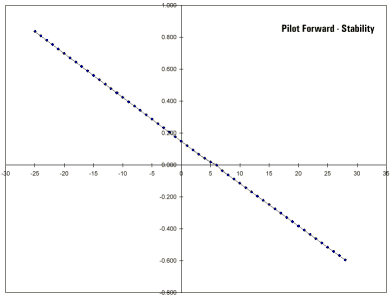
With the computerized pitch test vehicle, we have the option of plotting the pitching moment graphs around various center of mass locations. (In normal certification documentation, the graph is plotted about the reference point of the pilot hang point.) The first graph below is the graph of the stable configuration (VGT 3) re-plotted about a center of mass location that corresponds to the pilot pulling forward about 18″ from trim (bar somewhat below the pilot’s waist). The glider in this configuration is very stable. It has a single trim point, (the place where the curve crosses the x axis) at about seven degrees keel angle, which would correspond to a fairly fast flying speed. At angles of attack below that, the nose up pitch pressure rises sharply, and continues to rise as the angle is reduced. At angles of attack above seven degrees, the nose tries strongly to pitch down. Note that the top of the scale on the pitching moment axis in this graph is six times higher than on the original graphs – in other words, had we plotted this graph on the original axes, the slope would have been much steeper.
The second graph shows the stability plotted about a center of mass corresponding to a pilot who has pushed out about 18″ (basically full arms extension). Note that the glider has a trim point at about 32 degrees angle of attack (this would be above the angle at which the entire wing is stalled). Over the range of angles of attack down to zero, the glider has a positive pitching moment, though below about 12 degrees positive it begins to decrease rapidly. After zero degrees, the glider’s pitching moment becomes negative and as the angle of attack decreases further (or increases in the negative direction) the negative pitching moment increases rapidly. Note that the scale on this graph is also magnified.
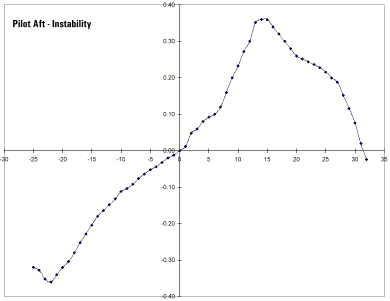
It should be obvious which graph you’d rather be flying if you happened to be in the process of pitching down through zero angle of attack. In the first graph, you would have a strong and strongly increasing tendency to pitch nose up, which would become greater and greater the farther nose down you pitched. In the second graph, you would have a diminishing nose up tendency while still above zero degrees, but then experience a strongly increasing pitch down tendency as you transitioned to negative angles of attack. This portion of the curve is a classic illustration of what is termed pitch divergence. The glider is pitching nose down and the farther it goes, the stronger is the tendency to pitch farther nose down.
So the moral of the story is keep your center of mass forward in rough air – fly with a little extra speed, and don’t try to max out the really violent thermals by pushing all the way out.