
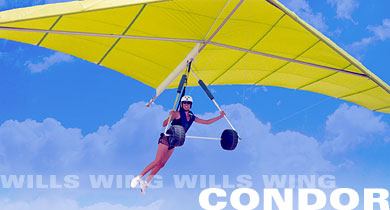
We stopped production of Condor 330 and Condor 225 in September 2013. We will continue to support the Condors in the field with spare parts and replacement sails, but we will not be making new Condors. Please read the information below comparing the Alpha and the Condor.
The Alphas fly very slowly, and are very docile and easy in handling, take-off and landing, and yet they have exceptionally good soaring performance – better in fact in very light lift and small thermals than a Falcon. Unlike the Condor, the Alpha is a fully airworthy, utility class glider, and can be sold to new students or experienced pilots. The Alpha will be a better first purchase glider for most new pilots than a Falcon, and almost as easy for first training flights as a Condor. In some ways they will be easier – because they are smaller gliders, they are easier to ground handle if there is wind. Their launching speed will probably not be quite as slow as the Condor, but it will be very close. The minimum flying speed on the Alpha 180 is within 1 mph of that of the Condor 225, and the minimum flying speed on the Alpha 210 is within 1 mph of that of the Condor 330, and almost 2mph slower than that of the Condor 225. Since the Condor is only approved for flight within a few feet of the ground, anyone who is going to progress beyond the first day of training will need to be able to adapt to launching something other than the Condor, and the Alpha is, by far, the easiest next step, and quite a bit easier in every respect than a Falcon.
The Condor is a special purpose glider for use by instructors in a training environment. (The Condor is not intended for use outside of a flight school, nor for resale to end users.)
The idea behind the Condor is simple – a student’s first attempts to solo launch a hang glider are easiest, and least intimidating if they occur on a small, shallow slope, at a very low groundspeed. Traditionally, the only way to achieve this low groundspeed was to have a moderate breeze present. The problem is that wind creates its own problems. It often blows from the wrong direction entirely, and even when the general direction is correct, it seldom blows from a completely consistent direction, or at a completely constant speed. Changes in either wind speed or direction cause problems for the student in ground handling the glider and balancing it prior to launch. Moreover, wind almost always involves at least some turbulence, which greatly complicates the student’s attempts to learn control of the glider in the air.
The Condor addresses these problems by allowing for a very low groundspeed without wind, and thus without the problems associated with wind. The Condor is a very large area glider, which allows it to fly very slowly. At the same time, it is extremely light in weight, making it easy for the student to lift, carry and ground handle.
The Condor thus allows for training at very low ground speeds in little or no wind. This makes the initial training process much easier and less intimidating for the student. Another benefit is that a suitable training hill becomes much easier to come by. A hill that is appropriate in shape, but doesn’t face into the normal prevailing afternoon wind might be useable in the early morning or late evening when there is no wind, with the added benefit that the air has no thermal activity and the heat of mid day can be avoided. All of these benefits of the Condor as a training glider serve to open up the hang gliding experience to a much broader range of people – people who may not have the athletic ability or the adventurous spirit necessary to try hang gliding in a more traditional training environment. Many instructors who have had the opportunity to use the Condor for first-flight training have subsequently refused to use any other glider for this type of training. During the re-opening ceremonies for Dockweiler Beach in Los Angeles, numerous reporters who came expecting only to cover the event found themselves participants instead, flying the Condor from the sand dunes because, well, it just looked so easy and like so much fun.
Condor Sizes
The Condor comes in two sizes – the original 330 and the new, smaller 225. The 330 Condor offers the slowest flying speeds in true no wind conditions, but it also has the most restrictive limitations. Most instructors report that the 330 Condor is “blown out” in winds of more than eight mph, due to the difficulty in ground handling such a large area glider in any significant wind. In addition, the 330 has the most restrictive operating limitations in the air – it trims increasingly nose down in a turn as the bank angle is increased, and it becomes unstable in roll beyond about 40 degrees of bank. The 330 also has the most restrictive structural margin – the airframe has an ultimate strength of only a little more than three G’s – less than half that of a typical utility class hang glider. Neither the Condor 330 or the Condor 225 is HGMA certified or certifiable, and neither is intended for utility class operation. Both models are recommended for footlaunch only (no towing) and for straight flight at low altitude, with minimal maneuvering, from a small, shallow slope. The Condor 225 has a bit more structural margin, is generally more stable than the 330, and could be used in a slightly expanded operating envelope. A first high flight in very light wind, very smooth, end of the day conditions – which would not be at all appropriate on the 330, could be done safely on the 225. Also, the 225 can handle a little more wind than the 330 before ground handling becomes a problem at the same magnitude, due to its smaller area and span. If you seldom have access to true no wind conditions, and typically train with some amount of wind and mild turbulence present, the 225 will work better for you than the 330. Having one of each, of course, provides the widest range of options.
Features
- Very lightweight – all 7075 airframe
- 7075 – T6 Pre-formed Battens
- Rear Crossbar Haulback System
- Deluxe Glider Bag, Control Bar Bag, Batten Bag, and Velcro Sail Ties
- Comprehensive Owner / Service Manual and Batten Diagram
- Very light weight
Specifications
| Specification | Condor 225 | Condor 330 |
|---|---|---|
| Area (ft^2) | 225 | 330 |
| Span (ft) | 35.8 | 39 |
| Aspect Ratio | 5.7 | 4.6 |
| Glider Weight (lbs) | 48 | 53 |
| Hook-In Weight (lbs) | 100-265 | |
| USHPA Rating | 1 | |
| Vne (mph) | 32 | |
| Va (mph) | 24 | |
| Vms (mph) | 15 | 13 |
| Vd (mph) | 43 | 32 |
| Length (in bag) (in) | 249 | 290 |
| Break-down (in) | 180 | 170 |
Comments
Hi Guys,
In the attachment a small film of me taking off with a Condor 330 from our training hill. Since I use the Condor I have banned all other hang gliders from [the training hill].
Sincerely, Diederik
Condor Feedback
I just wanted to give you guys some feedback on the Condor we are using in our Flight School now.
As far as the Condor as a trainer goes, It is great! It fills the gap between Paragliders and hang gliders. I think it is easier [learning to hang glide] than learning to paraglide, using the Condor. In fact I took one of my Paraglider instructors to the T-hill yesterday and gave him his first Hang glider instruction. You would not believe how excited he was . In fact he thought it was more fun than Paragliding, and he was getting perfect flights from the top of our training after only an hour or so of training. His first flight was on his feet and every one after was on his feet as well.
In the class with new students, it is a godsend. It makes my job so much easier, and I can relax more knowing that my students are going to have good flights almost every time. I don’t think any have NOT landed on their feet every time. I can even have the students fly the glider on flat ground in no wind, which was something only the most athletic students could do, and only if the wind was blowing at a good clip, when using my other trainers.
It is the best thing that has happened for my flight school.